KUALA LUMPUR HOTELS
ABOUT KUALA LUMPUR HOTELS
Kuala Lumpur Hotels reflect the city’s unique characteristics that blends modern luxury with local flavor. Whether one seeks the elegance of a high end hotel, warmth of a boutique experience or budget friendly accommodation Kuala Lumpur hotels offer a wealth of options that cater to every need and budget. The city not only serves as a gateway to explore Southeast Asia but Kuala Lumpur hotels also ensures a memorable stay through its diverse and welcoming accommodations.
The below listed choice hotels quoted in Malaysia Ringgit.
ABOUT KUALA LUMPUR
Kuala Lumpur is the vibrant capital city of Malaysia. It is a fascinating blend of ethnic cultures, modernity and tradition that makes it a prime tourist destination.
The city is located in the middle of the west coast of peninsular Malaysia (Malaysia includes Sabah and Sarawak on the north west side of Borneo Island).
Malaysia was formerly known as British Malaya during the British administration (1826 – 1957). The Malayan Union was a political entity established by the British on 1st April 1946 after the end of World War II. It was a way to consolidate the British territories in Malaya which included the Straits Settlements (Penang, Malacca, and Singapore) and the Federated Malay States. The Malayan Union was seen as a step towards decolonization and self-government for the Malay Peninsula.
The first western powers to set foot on the Malaya peninsular were the Portuguese from 1511 – 1641 with the capture of the Malacca sultanate. On January 1641 the Dutch along with their Javanese allies assaulted and drove the Portuguese out from Malacca. The Dutch ruled from 1641 – 1825.
Borneo Malaya was ruled by English man James Brooke (also known as Raja Brooke) starting in 29 April 1803 until Sarawak and Sabah joined the Malaysia union formation. Today remnants from these colonial era can still be seen in Malacca (Dutch Square, Christ Church and A Famosa fortress) and Penang (Fort Cornwallis).
The urban agglomeration “Klang Valley” (covering Kuala Lumpur, Putrajaya and the major cities on the western part of Selangor) is the term commonly used by locals.
About 9 million people live in the Klang valley (2 million in the Federal territory of Kuala Lumpur). The population ethnicity of Klang Valley comprise of Malay, Chinese, Indian, Eurasians and indigenous groups (Kadazan, Iban, Senoi, Negrito, e.t.c). The multi ethnicity population mix brings a wide array of festivals and celebrations for the country (from the Muslim holiday of Eid al-Fitri, the Chinese New Year, Hindu festival of Deepavali to the indigenous people Gawai festival celebration).
The “Malaysia Truely Asia” distinctiveness and allure warm is always ready to greet visitors with a smile. The country’s official language is Malay but English is widely spoken. Some Malaysian speak more than 3 languages. This makes it easy for tourists to communicate with locals. Malaysian hospitality is legendary as guests are often being treated like family by their hosts.
PLACES OF INTEREST IN KUALA LUMPUR
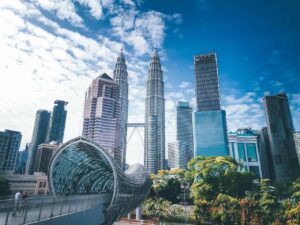
- Petronas Twin Towers is a soar 452 meters high structure standing majestically into the sky. The skybridge offers a breathtaking view of the city from the 84th floor. For safety reasons the skybridge will be closed during windy conditions or heavy rainstorm. Limited visitation on a daily basis with ticket purchase.
- Merdeka 118 (tallest building in Malaysia and the second tallest in the world) stands at an impressive height of 644 meters. It offers a breathtaking 360 degrees view of the city on the observation deck while providing space for cultural events and community engagement.
- Tengku Abdul Rahman Exchange Building at 492 meters (also known as the TRX Exchange) is the 2nd significant new landmark in the city’s skyline.
- Batu Caves is a striking limestone hill Hindu temple devoted to Lord Murugan. The god statue stands at 42.7 meters. The site is a focal point during the Thaipusam festival with thousands of devotees and tourists here. Visitors are greeted by 272 colorful steps leading to the main temple area.
- Bustling food courts are easily found around the city limits. They offer an authentic taste of Malaysian cuisine. Malaysian cuisine is an influence of traditional Malay, Chinese, Indian, Thai, and Javanese recipes. Many food courts are opened 24 hours everyday. A quality meal at the food court is relatively cheap compared the other cities in the South East Asia region.
BEST TIME OF YEAR TO VISIT KUALA LUMPUR
The city of Kuala Lumpur has tropical weather 365 days year round. The northeast monsoon rains occurs between December to February. Heavy rain may occur between transition months in November and March to April. The best time of the year to visit are from May to July and September to October (August has 20 days of unpredictable monsoon showers. These frequent daily monsoon shower will last between 5 – 20 minutes).
MORE ABOUT KUALA LUMPUR
The Malaysian Ringgit notes are denominated in 1, 5, 10, 20, 50 and 100 while coins are in 5, 10, 20 and 50 cents. Debit cards, credit cards and E-Wallet payments are widely accepted at food courts, transportation and outlet purchases. Travelers need not carry too much cash.
Getting around in Kuala Lumpur is easy with elaborately linked Metro Rail Transit, Light Rail Transit, Mono Rail, Commuter train system, taxis, E-Hailing and Public bus.
The electricity current in Malaysia is aligned to the British standard of 240 volts / 50Hz. Wall pugs are the standard UK 3 pin plug.
Malaysia is 8 hours ahead of GMT (GMT +8:00) and 16 hours ahead of US Pacific Standard Time.
Starting from June 1, 2024 visitors holding an embed microchip passport from 63 countries are eligible to utilize the AutoGate for immigration clearance.
KUALA LUMPUR DOS AND DON’TS
DOS
- Dress Modestly: Cover your shoulders and knees especially when visiting religious sites like mosques or temples.
- Remove Shoes: Take off your shoes before entering homes and certain religious places.
- Use Your Right Hand: Use your right hand (or both hands) when giving or receiving items.
- Be Polite and Respectful: Speak softly, calmly and be mindful of social hierarchies.
- Show Appreciation for Food: Accept offered drinks and food and compliment the hospitality.
- Learn Basic Malay Phrases: Even a few words can be appreciated by locals.
DON’TS
- Public Displays of Affection: Avoid excessive kissing, hugging, or touching in public especially in religious location.
- Pointing with Index Finger: Point with your thumb instead or use your whole hand.
- Touching Heads: Avoid touching anyone’s head, especially children’s as it’s considered disrespectful.
- Raising Your Voice: Speak calmly and avoid shouting as it can be seen as aggressive
- Disrespecting Elders: Show deference to elders and those in positions of authority
- Publicly Criticizing Race/Religion/The Royal Family: Avoid criticizing the royal family, a person’s race or religion.
- Ignoring Local Customs: Be mindful of local customs and etiquette, especially in homes and religious places.
- Illegal Drugs and Firearms: Penalties are severe for anybody in possession of illegal drugs or firearms.